
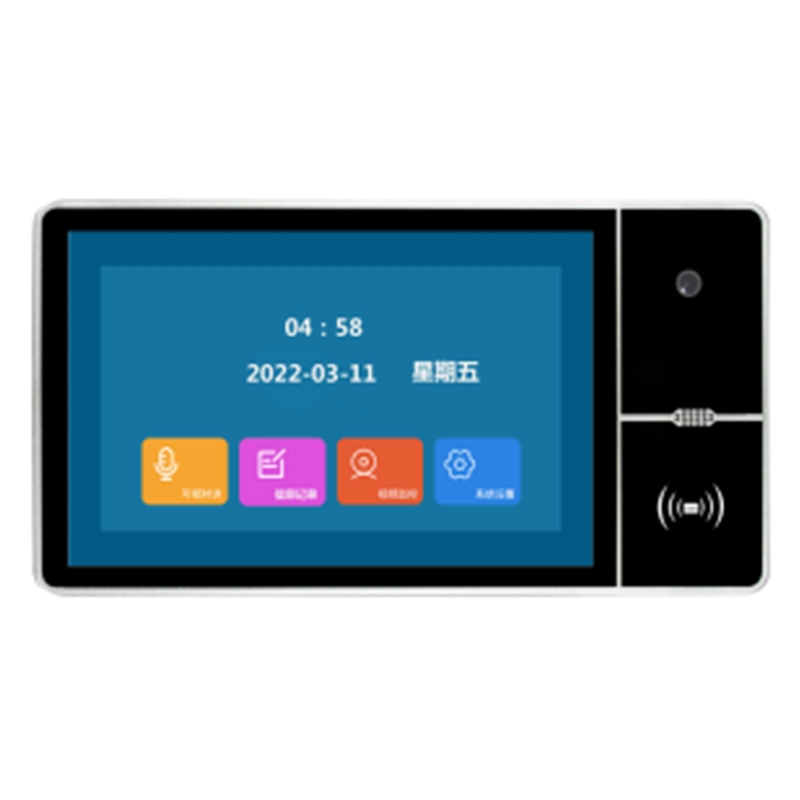
Every intercom project eventually reaches the same decision: which transmission technology to build on. It is the single choice that determines cable type, installation labour, future scalability and integration capability — and it is usually made too late, after the cabling design has already been drawn.
This article compares the three mainstream architectures honestly, including where each one stops being the right answer.
The Three Architectures at a Glance
Two-wire intercom
Power and data travel together on a two-conductor bus. Devices are daisy-chained or branched from bus distributors. No IP configuration is needed, and existing twisted-pair or even telephone-grade cabling can often be reused.
IP / network intercom
Each device is an independent IP endpoint on a standard Ethernet network. Devices are addressed logically rather than physically, communicate over TCP/IP, and can be managed remotely.
Analogue intercom
A traditional star topology: a distributor provides a fixed port per apartment, and each port maps to one address. Simple, robust, and limited in scale.
Comparison by Design Factor
- Cabling: two-wire needs two conductors (bus), the cheapest option; analogue needs a multi-pair star, moderate; IP needs Cat5e or Cat6 to every device, the highest material cost
- Installation labour: two-wire is lowest because it reuses or minimises cabling; IP is highest because it assumes structured cabling and configuration
- Typical capacity: analogue a few hundred addresses; two-wire often up to around a thousand; IP into the thousands and beyond
- Configuration: analogue and two-wire use physical addressing (dip switches or port mapping); IP uses software addressing and DHCP or static assignment
- Remote management: IP supports it natively; two-wire and analogue generally do not
- Third-party integration: IP integrates readily with BMS, CCTV, access control and elevators; two-wire requires gateways; analogue is largely closed
- Distance behaviour: two-wire bus loses voltage over long runs; IP is bounded by the 100 m Ethernet segment; analogue is bounded by distributor position
- Cost curve: two-wire is cheaper at small scale and rises gently; IP has a higher entry cost but a shallower per-unit curve
- Failure isolation: IP isolates faults per device; a bus fault on two-wire can affect every device downstream
Where Each Technology Wins
Two-wire wins in retrofit
The decisive advantage of two-wire is that it does not require new cabling in a building that already has some. In an occupied residential block, avoiding cable pulling is not just a cost saving — it avoids drilling, patching and tenant disruption, which is usually the real constraint on the project.
It also wins where the installers are not network engineers. There is no subnet planning, no IP conflict troubleshooting, no switch configuration. Physical addressing is set once and forgotten.
IP wins in new-build and integrated projects
If the developer is already installing structured cabling, the marginal cost of an IP intercom disappears. From that point on, IP gives strictly more capability: remote diagnostics, firmware updates without a site visit, event logging, mobile app calling, and clean integration with access control and building management.
IP also wins in projects with a long operating life. A building with 800 apartments will change its operating requirements over twenty years; an IP system can be reconfigured in software, whereas an analogue system is replaced.
Analogue wins in small and budget projects
For a low-rise building with a modest number of units and no integration requirement, analogue remains the most cost-effective answer. It is well understood by installers, uses readily available components, and is extremely stable because there is almost nothing to configure.
Its limitation is not reliability but ceiling: capacity, integration and remote management are all constrained by design.
Hybrid and Transition Scenarios
Real projects are rarely pure. Common hybrid patterns we support:
- Two-wire bus inside each building block, IP backbone between blocks. Keeps apartment cabling cheap while giving the site-level system IP management.
- Analogue in existing wings, IP in new wings. Lets a phased renovation add capability without touching the operational half of the site.
- Two-wire with an IP gateway for remote management and app integration, when new cabling is impossible but remote diagnostics are required.
Decision Framework
Answer these five questions in order, and the technology usually selects itself:
- Does usable cabling already exist? If yes and pulling new cable is difficult, start from two-wire.
- Is structured cabling already being installed? If yes, IP costs little extra.
- How many apartments and entrances, and how many will be added later? Above a few hundred addresses, analogue falls away.
- Must it integrate with access control, CCTV, elevators or a BMS? If yes, IP is the realistic choice.
- Will the site require remote support and firmware updates? If yes, IP again — or two-wire with a gateway.
Frequently Asked Questions
Can two-wire systems deliver full HD video?
Yes. Modern two-wire technology modulates high-bandwidth video data onto the bus and supports HD resolution. The older assumption that two-wire means low-resolution video no longer holds.
Is IP always more expensive?
Not necessarily. IP has higher cabling and configuration cost, but two-wire systems need bus distributors and dedicated power, which adds hardware as unit counts grow. The two curves cross, and where they cross depends on the building.
Which technology is more reliable?
Both are reliable when correctly designed. IP isolates faults to a single device, which makes diagnosis easier. Two-wire has fewer active components but a bus fault can affect multiple units, so cable quality and voltage drop calculation matter more.
Can we start with two-wire and migrate to IP later?
Only if the door stations and monitors support both, or if a gateway is available. Retrofit migration usually means replacing the door station and management layer at minimum. Plan for it at design stage rather than assuming it will be straightforward.
Conclusion
The right intercom technology is the one that matches the building cabling reality, its scale and its integration requirements — not the one with the lowest unit price. Decide the architecture before the cabling design, and the rest of the specification follows.
Shenzhen Iris Information Technology manufactures all three architecture families — Linux digital (IP), two-wire and analogue intercom systems — along with access control and accessories, so we can recommend the technology on project merit rather than on what we happen to build. Send us your building profile and cabling situation for an architecture recommendation.
About the Author
Written by the systems engineering team at Shenzhen Iris Information Technology Co., Ltd., developer and manufacturer of building intercom and smart access control systems.